

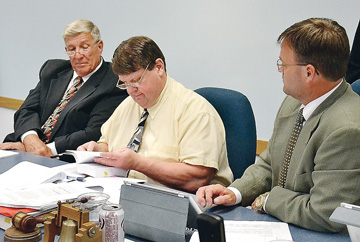

POCATELLO — Even the applause seemed tired as a weary Pocatello City Council voted 4-2 to pass an ordinance to protect members of the lesbian, gay, bisexual and transgender community from discrimination when it comes to housing, employment and public accommodations. It was
12:30 a.m. Friday, and they had listened to more than four hours of public testimony and internal discussion between council members.
Voting for the ordinance that contains only three modifications compared with one that failed in April were council members Roger Bray, Gary Moore, Steve Brown and Eva Nye. Those opposed were councilmen Craig Cooper and Jim Johnston.
Brown became the swing vote after an attempt to pass an ordinance with the same language as the one that died on a tie council tally with Mayor Brian Blad casting the deciding vote in April.
Language added to the ordinance that would have called for gender identification based on state driver’s licenses or official IDs in restrooms and locker rooms and an exemption for all employers with five or fewer employes were pulled before the measure passed.
An addition to the ordinance championed by Brown provides that the city will pay the first $250 for the cost of any mediation between a complaining party and person accused under the new city ordinance. The defendant would pick up the next $250 in cost and then additional costs would be split between the complainant and defendant. Mediation will be attempted before criminal charges are filed in a discrimination case.
Councilman Johnston made several attempts to table action on the ordinance as the meeting ticked past midnight.
“In many instances education can help resolve issues,” Johnston said. “How can we make people better without putting more laws on the books? Is a law going to change the climate?”
Bray, who pushed hard to find a compromise that would win majority approval from the council said laws do make a difference in the behavior of society.
“I’ve seen it make a difference,” he said, referring to personal experiences he had in the southern U.S. when it came to racial issues. “I think law does influence behavior.”
As council members wrestled with language changes that would make a compromise possible, Mayor Blad defended the addition of the use of state issued IDs when it came to public restrooms and dressing rooms.
That proposed change was widely criticized by people in support and opposed to the anti-discrimination ordinance for the LGBT community. It was labeled “ID to pee.”
“It’s not an ID to pee, it’s an ID to protect,” Blad said. “How do we protect the transgender person?”
The mayor expressed his frustration at trying to find a solution when it comes to public restroom use and making sure everyone’s rights were protected and that members of the transgender community were safe from harassment or attack.
“My intent with this was to protect the LGBT community,” Blad said.
The mayor also admitted that using driver’s licenses or state IDs as proof of gender was a less than perfect idea.
“I’ve never been totally sold on this,” Blad said.
During the council discussion, Brown suggested the public accommodations part of the ordinance could be scrapped and taken up at a later date, but then realized the omission would open the door to future problems.
“I think there’s a lot of work to be done,” Johnston said about the ordinance as he attempted to table it twice. His insistence that a motion to table the ordinance trumped previous council motions that had been seconded forced a delay as the council researched meeting rules.
“I think it is incumbent upon us to make a decision,” Bray said.
During the debate over meeting procedures, the city attorney who authored the anti-discrimination ordinance, Kirk Bybee, was asked to weigh in on the proper protocol.
“I’m against the concept of a filibuster,” Bybee said, drawing a chuckle from the crowd that had been in City Hall for more than six hours.
Passage of the ordinance will put Pocatello in the same camp as Boise, Sandpoint, Ketchum, Moscow and Coeur d’Alene when it comes to discrimination protections for members of the LGBT community in those cities.
Statewide, anti-discrimination protections are in place for people based on race, religion, gender, handicaps and religion.
Twenty-one states have added gender preference or orientation to that list. Idaho has not.

(0) comments
Welcome to the discussion.
Log In