


By Sean Ellis
POCATELLO — A 16.5-acre Pocatello property on Philbin Road was used as part of a long-running Ponzi scheme that bilked more than 400 investors of $31 million between 1999-2009, according to the U.S. Department of Justice.
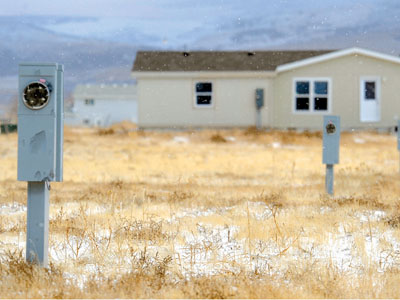
The Pocatello property at 4200 Philbin Road is inside a mobile home park formerly known as Philbin Estates but now called High Country Estates. The alleged conspirators behind the scheme reportedly sold investors several trust deeds worth a total of $1.92 million for undeveloped lots on the property.
The mostly vacant property is in the northeast corner of the mobile home park, and none of the existing mobile homes at High Country Estates are affected by the scam.
The alleged scheme mostly involved purchasing existing mobile home parks and converting them to mobile home subdivisions by dividing them into individual lots.
As many victims of the scheme have found out, a lot of the deeds are worthless since the lots were sold to multiple investors. According to federal prosecutors, many of the trust deeds were not filed on behalf of investors and most of the deeds that were filed were not the first encumbrance of the properties and are thus worthless.
While a court-appointed financial overseer is trying to recoup as much of the money as possible for investors, it appears unlikely they’ll see much of the money they were allegedly cheated out of.
The owners and operators of Valley Investments of Grand Junction, Colo., Philip R. Lochmiller, 61, and his son, Philip R. Lochmiller II, 38, as well as a company employee, Shawnee N. Carver, 33, were indicted by a federal grand jury in Denver Dec. 15 on conspiracy and fraud charges.
All three defendants have been arrested. Carver was released on her own recognizance, and both Lochmillers were released on $100,000 personal recognizance bonds.
The Pocatello property is one of five acquired by Valley Investments purportedly to develop affordable housing subdivisions.
The defendants are alleged to have duped investors by promising quick returns as high as 18 percent on investments they claimed carried no risk.
Before the indictment, the Colorado business was given to a receiver, a court-appointed financial overseer who is tasked with trying to recover as much money as possible for victims of the alleged scam.
“The receiver is essentially trying to get as much money as he can for the victims of the Ponzi scheme,” said Jeff Dorschner, a spokesman for the U.S. Attorney’s Office in Colorado. “It’s the government’s hope that through this process, as well as the criminal process, some money can be recovered (for the victims).”
However, he added, “It’s unlikely they’ll be made whole.”
The affected land in Pocatello was to be called the Llano Estacada Subdivision. Although infrastructure improvements have been made on the land, the property is vacant except for one modular home.
The receiver, Grand Junction attorney Kirk Rider, said the land includes 70 lots, 29 of which have been made the subject of investor liens ranging from $20,000 to $275,000. All of the liens are in second position, he said.
Rider said the amount investors actually recoup depends on how the court rules on the distribution scheme he is going to propose. He is going to propose all investors be treated equally, regardless of whether their trust deed is in first position or not.
“Whether they are in first position or not is really and mostly a matter of happenstance,” he said.
Rider said most of the victims in the scheme are elderly investors from the Grand Junction area.
According to the indictment, Valley Investments, which was first called Valley Mortgage, was incorporated in Colorado in 1994. The business entered into the affordable housing real estate development and housing sales business beginning in 1999.
The business mainly involved the acquisition — using investor funds — of vacant land or existing mobile home parks, which were converted to mobile or manufactured home subdivisions. To finance the properties, the Lochmillers advertised and solicited investments from individuals by promising a short-duration, high-percent interest rate to be paid monthly.
The investments were advertised as “solid security” secured and recorded by a deed of trust in the investor’s name. The Lochmillers allegedly represented that the company generated large profits by selling manufactured homes together with lots within their subdivisions.
They later promised investors returns as high as 18 percent. Investors were supposed to receive a promissory note and a recorded deed of trust on individual lots worth a minimum of $20,000.
The defendants allegedly continued to solicit investor funds for several years despite knowing the business was not generating sufficient profit. Because the business was not sustainable, the defendants allegedly used new investor funds to make interest payments to existing investors.
The indictment alleges the elder Lochmiller failed to disclose a prior conviction for securities fraud in California. In that case, Lochmiller was sentenced in 1985 to three years in prison.
It also alleges the Lochmillers failed to inform investors that the Colorado Division of Securities ordered Valley Investments in June 2001 to cease offering and advertising unregistered securities. Both men also allegedly failed to disclose prior bankruptcy filings.
The indictment alleges the three defendants conspired to devise a scheme to defraud and obtain money or property through false and fraudulent pretenses, representations and promises, and schemed to commit securities fraud.
Carver is alleged to have notarized forged signatures of investors for fraudulent releases of trust deeds.
Less than two weeks after the state of Colorado ordered the business to cease and desist in May, the business closed its doors.
One of the victims of the alleged scam who contacted the Journal by e-mail has established an e-mail address to communicate with other investors and provide them with regular updates. The e-mail address is vivasucker@gmail.com.
The investor said “vivasucker” stands for Valley Investments Very Angry Sucker. According to the investor, at least one affected investor has committed suicide because of the alleged scam.
Anyone who believes they were a victim of the alleged scam can call U.S. Department of Justice contacts Donna Summers or Carol Morris at 303-454-0100 or 888-751-4450.
The case was investigated by the Federal Bureau of Investigation, the Internal Revenue Service, and the U.S. Postal Inspection Service, with assistance from the state of Colorado Division of Securities and Mesa County Sheriff’s Office.

(2) comments
Oooops - Philip R. Lochmiller's mother's name is Jo Alice [not Ann] - that's three generations of Lochmillers involved in fraud/criminal activities!
CLARIFICATION: The suicide stemmed from the California scam in which Philip R. Lochmiller, his mother Jo Ann, and his brother, Stephen were convicted. The impact of this current swindle has disrupted and devastated too many lives. It is a sad state of affairs when the three Valley Mortgage indictees are out free to enjoy the Christmas holidays – at taxpayers' expense? This ordeal is just beginning …
Welcome to the discussion.
Log In