

By Sean Ellis
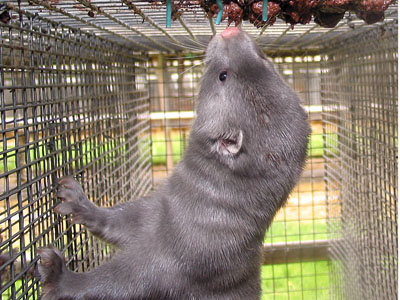
A national animal rights group is blasting Idaho for its treatment of mink, calling the Gem State the third-worst in the nation for its treatment of animals farmed for their fur.
According to a news release by the national wildlife advocacy organization Born Free USA, Idaho earned its place near the top of the list for its high number of unregulated mink farms.
While the Idaho State Department of Agriculture has the authority to inspect fur farms, it chooses not to, the release said. The group also accuses Idaho of having “one of the broadest anti-cruelty statute exemptions in the country.”
Idaho’s 24 mink farms produced 228,000 pelts in 2008, which ranked the Gem State third in the nation. Wisconsin, the national leader, produced 910,000 pelts in 2008, according to the U.S. Department of Agriculture. Utah ranked second with almost 550,000 pelts last year.
Several of Idaho’s mink farms are located in the Franklin County area, but farm owners would not speak to the Journal on the record about the claims. They’re afraid of being targeted by animal rights groups, which they claim routinely raid their farms and let their animals loose.
“I don’t know about Born Free, but certainly there are groups that do that,” said Teresa Platt, executive director for Fur Commission USA, headquartered in Coronado, Calif. “They do an awful lot of damage.”
Born Free’s 44-page report reviews statistics and legislative oversight of animals raised for their fur. According to the report, while the ISDA’s Division of Animal Industries has authority to inspect mink farms at any time, because the farms are not required to be licensed in Idaho, having the authority to inspect them is meaningless.
Mink farming is not federally regulated and since mink are listed as domestic livestock, mink farms fall under the jurisdiction and regulation of individual states.
Under Idaho statutes, the ISDA does have the authority to inspect, but mink farms are not required to be licensed in this state. However, the state does have a voluntary inspection program and more than half the state’s mink farms are enrolled, according to Dr. Bill Barton, the state vet.
Inspections encompass the entire facility, he said, and include checking cages, ensuring proper sanitation techniques are used, reviewing the farm’s feeding and watering protocol, and ensuring humane euthanasia techniques are used.
The ISDA also has the authority under the state’s animal neglect and cruelty statutes to inspect any facility if the department receives a complaint about it. Barton said the department has not received any complaints about mink farms during his three years with the ISDA.
Though mink farms aren’t required to be licensed in Idaho, “It’s not to say ... mink farms are willy-nilly doing whatever they want,” Barton said.
Born Free’s report also claims animal cruelty is a problem at Idaho’s mink farms, and the group says it is concerned with the potential of caged animals spreading diseases to native wildlife, as well as animal waste from the farms causing environmental pollution.
Platt called the report “animal rights propaganda.”
“They are obviously people who don’t support the use of animals for anything,” she said. “I don’t think there’s anything we can do to please these people because, philosophically, they’re against using these animals for human benefit. No matter how well we care for these animals, it’s not going to make them happy.”
Platt said North American mink pelts are recognized as among the best in the world. “That’s not easy to do if you’re not taking care of your animals.”
While the number of mink farms in the U.S. has plummeted from more than 1,000 in 1975 to 274 in 2008, the number of pelts produced in this country has mostly held steady at about 2.8 million.
The 2008 U.S. pelt crop earned $115.6 million, down sharply from $185.8 million a year earlier. The average price per pelt in 2008 fell to $41.50 from the all-time high of $65.70 set the previous year.

(7) comments
my post didn't show up and the LTE e-mail address bounced so I'm reposting this again. sorry for any duplicate
The industry claims that fur farming and good welfare go hand in hand — the prevailing scientific evidence does not support this assertion. According to the European Commission Scientific Committee on Animal Health and Animal Welfare (SCAHAW), “fur clarity and density do not correlate with any other welfare measure ... mink pelt condition is probably best considered a production measure rather than a sensitive welfare measure …”
Clearly, the industry sees keeping animals in small, barren wire cages as good for profits, but such housing is nowhere near meeting the behavioral needs of these naturally active inquisitive animals, and is in stark contrast to how they would live in the wild.
Idaho State Veterinarian Dr. Bill Barton pointed to the state's "voluntary" program as a substitute for enforceable state regulations, and asserted that he had not had complaints about fur farms in his three years in that post.
Of course he hasn't heard any complaints! The fur farms are not open to the public, no state agency inspects the farms, and if they did there are no enforceable standards to form the basis for a complaint.
Dr. Barton did not mention how frequently (if ever) fur farms participating in the "voluntary” program are visited. Again, even if they were found not to be in compliance with even the minimal recommendations, there would be no consequence.
Certification and inspection by an entity simultaneously concerned with industry promotion and membership recruitment smacks of a considerable conflict of interest. Ultimately, to be meaningful, guidelines, codes of practice or recommendations need to be legally enforceable by an independently objective, appropriately mandated agency.
Man's Inhumanity Never Ceases To Amaze Me...
the whole fur thing is SO cruel no matter how you conduct your business. haven't you seen any undercover footage of these practices? frankly, i'm stunned that this country is still so backwards to think any fur farm is acceptable. it reminds me of the 50's when people thought it was acceptable to abuse/beat their children. hello? wake up! it's already 2010 and we're still making fur??!!
As a long-time animal adovcate and compassionate and caring human being,
I find the three comments here nothing less than appalling. You gloss over the reality of what we are doing to other sentient, living beings for nothing more than shallow vanity. You should all hang your miserable heads in shame.
Minks are aquatic creatures by nature. Imprisoned in cages, they have absolutely no opportunity to engage in their natural behaviors. Just for one day, I wish you all could be imprisoned in small cages with nothing to occupy your time. Obviously you've not watched the way most farmers kill minks. If there is no inspection and oversight by either the Idaho government or USDA, do you really believe these farmers care enough about the minks to actually provide good care and quick, humane deaths. But in essence, if they actually "cared" at all, they wouldn't be in this business, period.
All you people ever do when confronted with indisputable cruelty and exploitation is attack the messenger. You love to accuse anyone and everyone of "terroristic" actions and call those of us who have a deep sense of compassion and empathy wackos and extremists.
I've got news for you. If caring about animals and committing my life and my voice for them paints me as an "extremist", then so be it. I am supremely proud. To care for and be concerned about all life is the mark of a truly civilized being.
In addition to getting a life, the mink farmers should also make an appointment with the Wizard of Oz. Clearly, all connected to the fur industry is bereft of a heart.
How sad.
Both HSUS and PeTA send out releases without any real studies performed.
The German High court found PeTA guilty of staging videos and causing animal abuse.
For years the public has been subjected to images of animal abuse that have been manipulated and staged. Such images have been used to damage the reputations of
legitimate businesses. Legal action was taken against Dr. Edmund Haferbeck of PeTA Germany and a Board member after showing faked videos. This material had the effect of
discrediting the quality security system and its legitimate partners.“We are pleased about
this very clear outcome of the lawsuit against Dr. Haferbeck”,commentates Dr. Walter
Scheuerl, the QS’ attorney on their success. In a parallel procedure against PeTA
Germany and a PeTA Board member, the chamber ruled that PeTA must provide proof regarding the origin of the photos and the film footage which PeTA has been using.
What are the 12 steps of the the animal rights agenda?
1. Abolish by law all animal research. (There would be no cures for AIDS, cancer, heart disease, etc., and testing of new drugs would be done on humans, or not at all.)
2. Outlaw the use of animals for cosmetic and product testing, and classroom demonstration (physicians would perform their first surgeries and procedures on humans without any previous experience).
3. Vegetarian meals should be at all public institutions, including schools.
4. Eliminate all animal agriculture (resulting in no milk, eggs, chicken, fish, or meat for food, no leather for shoes or clothing). (How many foods do you eat that contain eggs or dairy products, or a derivative of the same? Did you know your keyboard and mouse may have been made with animal products?)
5. Eliminate all herbicides, pesticides or other agricultural chemicals. Outlaw predator control.(Farmers would not be able to produce as much food as they do now, driving the
cost of living up, and eliminating the export of food to hungry nations. Animals such as coyotes are already a problem in some areas, coming into yards to eat garbage and prey upon outdoor pets.)
6. Transfer enforcement of animal welfare legislation away from the Department of Agriculture. (Animal issues would be controlled by people with little or no experience in customary animal husbandry.
7. Eliminate fur ranching and the use of furs.
8. Prohibit hunting, trapping and fishing.
9. End the international trade in wildlife goods.
10. Stop any further breeding of companion animals, including purebred dogs and cats. Spaying and neutering should be subsidized by state and municipal governments until all companion animals are extinct. Abolish commerce in animals for the pet trade. Eliminate
pet ownership.
11. End the use of animals in entertainment and sports (resulting in no horse shows, cat
or dog shows, animal actors, rodeos, animal movie stars).
12. Prohibit the genetic manipulation of the species (resulting in the elimination of critical medical research relating to Cancer, AIDS and other life threatening diseases, as well as crop production improvements such as the difference between the Holstein and the
Angus, and eliminate all pedigreed animals, etc... ).
Excellent comments, EdenSprings. This is an Animal Rights group which means they know next to nothing about animal husbandry and NO type of confinement is acceptable for them. They will only be happy when humans and animals have no interaction at all. Too bad the Statesman didn't research the group first.
Why, when the end product of the mink farmer is a good shiny pelt, would they do anything that would make the animals ill or stressed? Ridiculous.
I'm pleased to see that your article admits to being entirely biased, especially when it comes to the "facts" having been supplied by this Extremist group which was likely the very same one to have recently staged a protest in Morgan.
Oddly enough, they failed to boast about the criminal convictions several of their key organizers have garnered, or the placards they carried showing an automatic weapon under the words "No Compromise".
It's unfortunate that they don't have a similar regard for the Constitutional rights of the livestock farmers and pet owners of this great nation as they do for these mink.
As their patron saint, Ingrid Newkirk, founder of PETA is fond of saying, she'd rather see one lab rat saved than find a cure for cancer or AIDS.
I have two questions: 1) when everyone who owns, raises, eats or wears an animal or any animal product is a criminal, who will run society? 2) how can people who claim to care so much for animals care so little about their fellow man?
Welcome to the discussion.
Log In